Whatsapp

When most people think about male pleasure, the penis gets all the attention. Meanwhile, a small gland a few centimetres inside the body sits there quietly, packed with nerves and mostly ignored. That's the prostate gland, and for a lot of people with prostates, it's the most underrated pleasure spot they own.
If you're curious but a little nervous, that's completely fair. Nobody in school or at home explained this part. So here's the guide you never got: what the prostate actually is, how to find it, how to enjoy it, and how to keep it healthy for the long run.
What You'll Learn
- What the prostate gland is and where it sits
- How to explore prostate play and reach a P-spot orgasm
- Signs that something might be off with your prostate
- How to care for your prostate as you get older
Understanding the Prostate Gland
It's tempting to skip straight to the fun part. But poking around without knowing where the prostate is, or how gently that area needs handling, is a quick way to turn curiosity into discomfort. Five minutes of basics first makes everything after it feel a lot better.

What Is the Prostate?
Your prostate gland is roughly the size of a walnut and weighs about 30 grams, according to Cleveland Clinic. It's wrapped in muscle and connective tissue, which is why it feels firm but slightly springy when you press on it. If you were assigned male at birth, you have one, and that includes many trans women, who usually keep their prostate after transition.
Anatomists describe it in sections, or lobes, as outlined by the US National Cancer Institute's SEER training site:
- Anterior lobe: the front section, sitting ahead of the urethra. It's made of muscle and fibrous tissue rather than gland tissue.
- Median lobe: a small cone-shaped section tucked between the ejaculatory ducts and the urethra.
- Lateral lobes (left and right): these make up most of the gland, with the urethra running between them.
- Posterior lobe: the back portion, and the part a doctor (or you) can feel through the rectal wall.
That last one is the bit that matters for pleasure. It's the side facing your rectum, which is exactly why internal play can reach it.
Where Is It Located?
The prostate sits just below your bladder, above the pelvic floor muscles, and right in front of your rectum. Picture it hugging the urethra, the tube that carries both pee and semen out of your body.
There are two ways to feel it:
- Indirect stimulation, through the perineum
- Direct stimulation, with a finger inside the anus
For the indirect route, find your perineum. That's the patch of skin between your balls and your anus. Press the middle of it with your index or middle finger and slowly increase the pressure. You'll often feel a dull, pleasant sensitivity. It's milder than direct contact, but it needs zero prep and it's easy to try even when you share a home with family or flatmates.
For the direct route, coat your index or middle finger with water-based or silicone-based lube and slide it in slowly, about 5 centimetres, or roughly up to your second knuckle. Curl your fingertip toward your belly button and feel for a rounded, slightly rubbery bump. Light pressure there usually brings a very particular "oh, hello" sensation. That's your prostate.
What Does It Do?
Pleasure is a bonus. The prostate's day job is making fluid. It adds a milky liquid to semen that contains enzymes, zinc and citric acid, which help keep sperm healthy and moving.
Its muscles also squeeze during orgasm to push semen through the urethra. So whether you've ever thought about it or not, your prostate already plays a part in every orgasm you have.
Exploring Prostate Play
Now for the part you've probably been waiting for. Before you start, keep lube within reach and give yourself proper time. Prostate play doesn't do well with a ticking clock or a family member about to knock on the door.
Why the Prostate Gland Is Called the "Male G-Spot"

Honestly, science hasn't fully nailed this one down. A 2018 review in Clinical Anatomy points out that the exact mechanism behind prostate orgasms still hasn't been precisely described.
What we do know is that the gland is surrounded by a network of nerves called the prostatic plexus, so there's a lot of wiring in a small space. Your brain matters too. When you relax and actually focus on the sensation, it usually feels much stronger than when you're tense and distracted.
The comparison to the G-spot also comes down to how it behaves. Both are internal, both respond to firm pressure more than light touch, and both can feel elusive until you know exactly where to aim. And since only people with prostates have one, it's a big part of why anal play can feel so different for them.
One more thing, because this worry comes up a lot. Enjoying prostate play says nothing about your sexuality. Straight, gay, bi or still figuring it out, the nerves are the same.
Prostate Play Techniques
Ready? Start with your fingers. They give you the most feedback, and once you know what you like, sex toys can take over the hard work.
1. Classic Rub

Slide your finger in, find the prostate, and keep your finger fairly straight. Then rub gently in different directions: up and down, side to side, or in small circles. The trick is staying on the gland itself so the sensation builds instead of coming and going.
2. Come Hither

This is the one you'll hear about most. Curl your fingertip toward your belly button and make a slow "come here" motion, the same way you'd wave someone over from across a room. Keep steady pressure on the prostate as you do it.
3. Doorbell
Similar position, different rhythm. Instead of stroking, tap the prostate with your fingertip as if you're pressing a doorbell. Start soft and build the pressure slowly once it feels good.

4. In and Out
 This one adds the anal opening into the mix, and that area is full of nerve endings of its own. Slide in until you reach the prostate, give it a gentle press or rub, then slowly draw your finger back until only the tip is inside. Don't pull all the way out. Repeat at whatever pace feels right, or switch to another technique when you want a change.
Prostate Play Tips
Your comfort comes first, especially the first few times. These tips make the difference between "never again" and "why didn't anyone tell me sooner."
1. Prep before you play.

Jumping straight in without a little preparation is how things get uncomfortable or messy. A few minutes of prep sorts most of that out.
- Trim and file your nails. The skin inside is delicate, and a sharp nail edge can cause tiny tears that sting and raise the risk of infection.
- Keep lube close. Use a water-based or silicone-based one. The anus doesn't make its own lubrication, so this part isn't optional.
- Freshen up. A shower or a quick wash with the health faucet covers most people. Stool usually sits higher up and only moves down when you need to go, so full douching isn't always necessary. If your stomach's been unsettled, wait for a better day.
- Pick your moment. Choose a time when you're actually alone and not expecting a delivery, a call from home or a flatmate walking in.
2. Take your time.
Rushing makes you nervous, and nerves make your muscles tighten. Tight muscles make everything less comfortable. Start slowly, breathe deeply, and spend some time touching yourself everywhere first. The best moment to go inside is when you're already relaxed and turned on.
3. Skip numbing sprays at first.

You've probably seen anal creams and sprays that promise to numb or relax things down there. They have their place later on. For your first few sessions, though, you want to feel everything. Pain is your body's way of saying "slow down," and numbing it takes that signal away. Plenty of lube does the comfort job without dulling anything.
4. Pair prostate play with other erogenous zones.
Prostate play needs only one hand, which leaves the other one free. Use it on your penis, your nipples or your inner thighs. Stacking sensations like this is often how people reach their strongest orgasms.
5. Practice is the key.
First try felt more awkward than amazing? That's normal. A new sensation takes a few sessions before your body learns to read it as pleasure, and a lot of people first feel a "need to pee" sensation because the prostate sits right next to the bladder.
Come back to it another day. It usually gets easier and better each time.
Recommended Prostate Sex Toys
Once you know your way around, sex toys can do things fingers can't. They reach the right angle without cramping your wrist, some vibrate or move on their own, and a few can be handed over to a partner. Here are four types worth knowing.
1. Prostate Massager
Prostate massagers are built for exactly this job. Most have a slim, curved shaft and a rounded head that naturally settles against the prostate once it's in, though you might need to adjust the angle a little. Many add vibration, and some higher-end models rotate or move so you can just lie back.
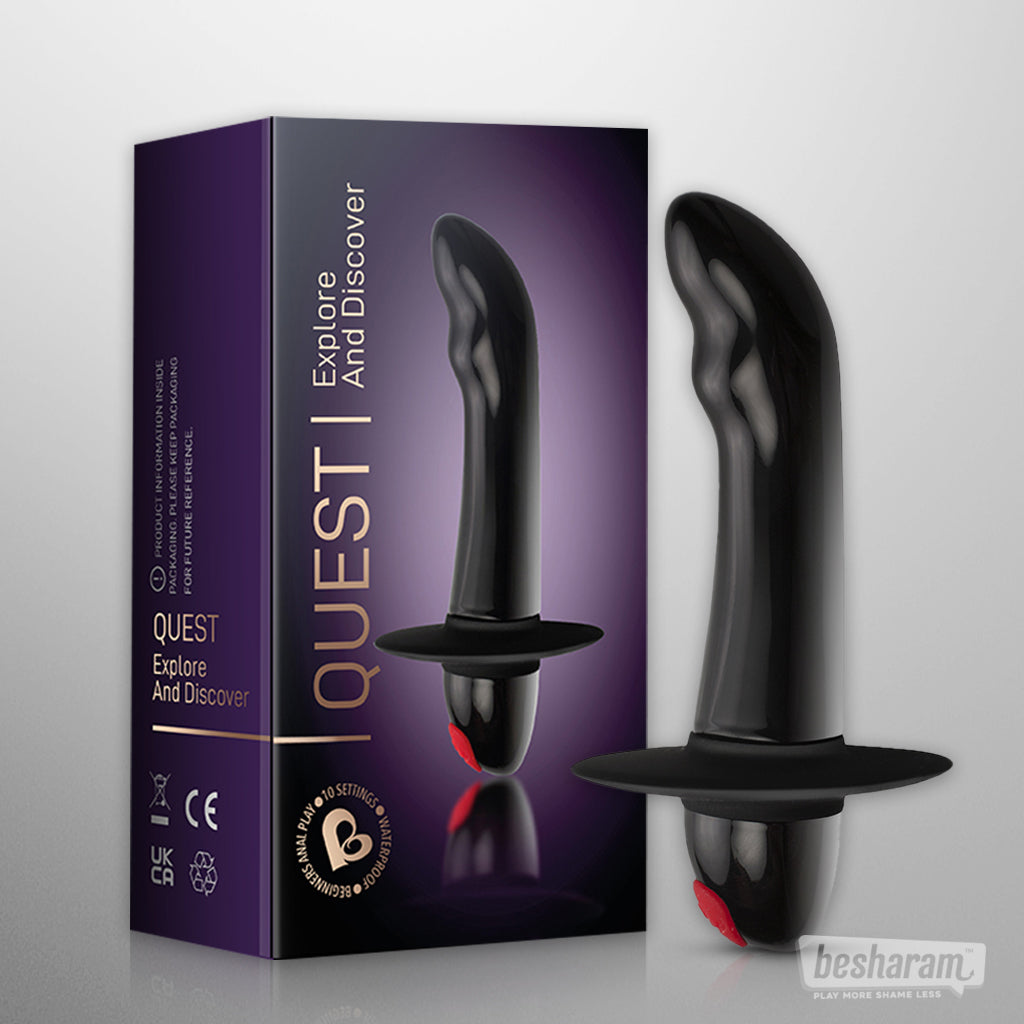
If you're starting out, the Rocks Off Quest Prostate Massager is an easy first pick. It's slim, with 3 inches of insertable length, a flared silicone base and 10 vibration settings, and it runs on a single AAA battery that's included. It sits in the budget tier, which helps when you're not sure yet how much you'll love it.
How to use: Add water-based lube to the shaft and get comfortable, lying on your side with your knees pulled up works well. Insert it with the curve pointing toward your belly button, switch on the vibration at the lowest setting, and work your way up.
2. Vibrating Butt Plug
A vibrating butt plug is a good choice if you love the feeling of fullness. Plugs have three parts: the body that goes inside, a narrower neck, and a flared base that stays outside and often holds the controls.
 A plug doesn't target the prostate as precisely as a massager, but its shape still presses nearby, and the vibration spreads through the whole area. The EasyToys Butt Buzzer Vibrating Butt Plug is a friendly size for beginners, with 3.66 inches of insertable length, a maximum diameter of about an inch, 10 vibration settings and a pull ring for easy removal. It's rechargeable, so no hunting for batteries.
How to use: Lube the plug's body, get into a comfortable position, and ease it in slowly until the neck settles. Then turn on the vibration and let it do its thing, alone or during sex with a partner.
3. Anal Dildo
Want more stretch and more control over movement? An anal dildo is basically a dildo with a flared or suction base, so it can't slip all the way in. That base is the key difference, and it's non-negotiable for anal play.
 The Strap-on-Me Curvy Dildo Plug is made of soft liquid silicone, around 6 inches long and 1.65 inches wide, with a curved shape. It has a strong suction cup and works with a harness, which makes it a fun option for pegging if you and your partner want to explore that together.
How to use: Lube up, get comfortable and insert slowly. Move it in and out with the curve angled toward the front of your body to press on the prostate. With a suction base, you can stick it to a smooth tiled wall in the bathroom and try different positions.
4. Anal Probe
In hospitals, "anal probe" means a medical instrument. In sex toy terms, it's a slimmer cousin of the anal dildo, with a narrow shaft and a slightly bulbous or tapered tip. That slim shape lets you press on the prostate with more precision.
 The Aneros Helix Trident Male Prostate Massager works on a similar slim, precise idea. It has a thin stem and an angled head, and it has no motor at all. Once it's in, gentle clenches of your pelvic muscles rock it against your prostate and perineum, which makes it completely silent. Fair warning: it rewards patience, so the first couple of sessions may feel quiet.
How to use: Lube the shaft, get into a comfortable position and insert slowly, with the tip angled toward the prostate. With a hands-free toy like the Aneros, relax first and let your muscles do the work.
Want to browse more shapes? Check out the full range of anal sex toys for men.
Learn more about Anal Play
Want to keep learning about prostate play and anal play in general? These IMBesharam guides are a good next stop:
Beginner's Guide to Anal Play for Men
Hygiene, lube, finding the prostate and choosing your first toy, explained simply.
How to Choose Your First Butt Plug
Sizes, shapes and materials, so your first plug feels right from day one.
10 Things No One Told You About Butt Plugs
The practical stuff people usually learn the hard way.
Male Sex Toys for Your Next Bedroom Play
A wider look at toys for men, from strokers to prostate massagers.
Caring for Your Prostate
It's a small gland, but when it isn't happy, you'll notice. Here's what to watch for, the most common conditions, and a few habits that genuinely help.
Warning Signs to Watch For
See a doctor soon if you notice any of these. They could point to a prostate issue or something else, and either way they're worth checking:
- Needing to pee often or urgently
- Blood in your urine or semen
- Pain or burning when you pee or ejaculate
- Trouble controlling your bladder, including waking up several times a night to pee
- A weak stream, or a stream that stops and starts
Common Prostate Health Conditions
These are the conditions most often linked to the signs above. This is general information to help you understand what a doctor might look for, not a way to diagnose yourself. If something feels off when you pee or ejaculate, book an appointment.
1. Benign Prostatic Hyperplasia (BPH)
BPH simply means an enlarged prostate. As the gland grows, it can squeeze the urethra, so your bladder has to work harder. That's what causes the slow stream and the constant feeling that you need to go. It's not cancer.
It usually shows up after 40 and becomes very common with age. According to the US National Institute of Diabetes and Digestive and Kidney Diseases, a family history of BPH, obesity, type 2 diabetes and low physical activity all raise the odds.
To diagnose it, doctors usually start with a digital rectal exam, a urine test and a blood test, sometimes including a PSA test. Depending on what they find, they might add a urine flow test, an ultrasound or other checks.
Treatment depends on how big the prostate is, your age and how much the symptoms bother you. Doctors often start with medicines such as alpha-blockers or 5-alpha reductase inhibitors, and Mayo Clinic notes tadalafil is sometimes used too. If medicine isn't enough, there are procedures to relieve the blockage.
2. Prostatitis
BPH is about growth. Prostatitis is about inflammation, and it's one of the most common urinary complaints in men under 50.
There are a few types, each with a different cause:
- Chronic prostatitis, or chronic pelvic pain syndrome: the most common type. There's often no infection behind it, and the exact cause isn't always clear.
- Acute or chronic bacterial prostatitis: caused by a bacterial infection. The acute kind comes on suddenly and usually clears up with treatment. The chronic kind builds slowly and can keep coming back.
- Asymptomatic inflammatory prostatitis: causes no symptoms and usually turns up only during tests for something else.
A recent urinary or reproductive tract infection, HIV, and nerve damage in the pelvic area can raise your risk.
Diagnosis usually starts with a conversation, then a digital rectal exam, urine and blood tests, and sometimes a test of prostate fluid. For bacterial prostatitis, Mayo Clinic says antibiotics are often taken for 4 to 6 weeks, sometimes alongside alpha-blockers to ease urinary symptoms.
3. Prostate Cancer
Prostate cancer is one of the most common cancers in men. In its early stages it often causes no symptoms at all, which is exactly why checkups matter. When symptoms do show up, they can look a lot like BPH: peeing more often, straining, or a weaker stream.
The good news is that prostate cancer often grows slowly, and finding it early makes treatment much more effective. More advanced cases can bring other symptoms, like back or bone pain, erection problems or unexplained weight loss.
Your risk goes up with age, especially after 50, and if a close relative has had prostate cancer. The NHS also lists a family history of breast or ovarian cancer as worth mentioning to your doctor, since some of the genes involved overlap.
Tests usually start with a digital rectal exam and a PSA blood test. If those raise questions, you'll be referred to a specialist, who may suggest an MRI scan and a biopsy.
If you ever do get this diagnosis, feeling scared is completely normal. Depending on the situation, treatment can range from careful monitoring to surgery, radiotherapy or hormone therapy. Lean on people you trust. You don't have to handle it alone.
How to Support Prostate Health
No warning signs right now? Great. A few everyday habits can help keep it that way.
1. Move more and eat well.
Yes, it's the same advice you've heard for everything else, and it applies to your prostate too. In a study of more than 30,000 men, those who were more physically active were less likely to have BPH symptoms, and even regular walking at a moderate pace helped, as Harvard Health explains.
On the food side, the same advice applies. Aim for at least five servings of fruit and vegetables a day, choose whole grains over refined ones, and get your fats from things like nuts and olive oil. Go easy on sugary drinks, salty snacks, red meat and heavily processed foods. Your mother's dal, sabzi and roti covers a lot of this already.
2. Ejaculate regularly.
This one's a lot easier than a diet overhaul. A long-running US study that followed nearly 32,000 men for about 18 years found that men who ejaculated 21 or more times a month had roughly a 20 percent lower risk of prostate cancer than men who ejaculated 4 to 7 times a month. You can read the study summary on PubMed. It shows a link rather than proof, but it's a good reason to drop any leftover guilt about masturbation.
3. Get regular checkups.
Most guys would rather do almost anything than a prostate exam, mostly because it involves the bum. Honestly, it takes a few seconds and it's far less dramatic than people imagine.
Skipping checkups, for your prostate or anything else, means problems get found later, when they're harder to fix. As you get older, ask your doctor when it makes sense to start prostate screening.
Feeling shy about a rectal exam? Urologists do them every day. To them it's as routine as checking your blood pressure.
Your Prostate Gland, Finally Introduced
That little walnut nobody mentions at the dinner table turns out to do quite a lot, from keeping your plumbing working to making orgasms feel deeper. Get curious at your own pace, and when you're ready to explore, our prostate massagers collection comes with discreet, private delivery.